
Pavement planning guide · North Texas
Mill & overlay or full reconstruction: what does the pavement need?
The decision is not based on how rough a lot looks from the street. It depends on what remains structurally useful, where water goes and how the pavement is loaded. An overlay renews a surface; reconstruction replaces the failed section.
What mill and overlay retains
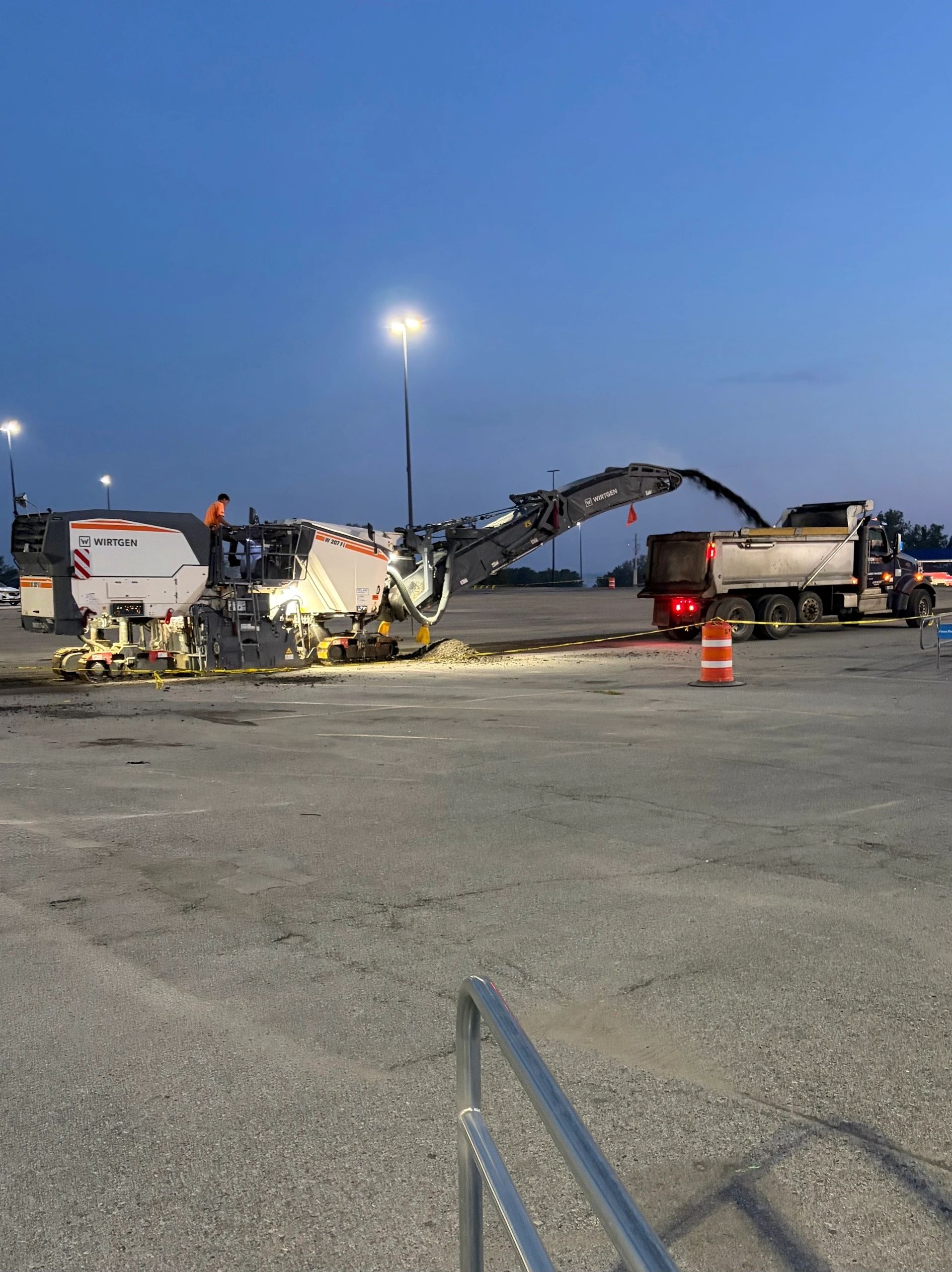
Mill and overlay removes a planned depth of existing asphalt and places a new course, generally retaining the underlying pavement and support. Targeted full-depth repairs may be included where failures are isolated.
Milling makes room for the new surface at curbs, inlets and entrances. Removal depth should follow the existing section and proposed design rather than a universal depth. Bonding, transitions and drainage still need attention.
What full reconstruction replaces
Reconstruction removes the pavement section within defined limits and rebuilds support and surfacing as required. It can address widespread inadequate thickness, unstable base, subgrade problems or grades that cannot be resolved by a surface treatment.
It usually involves more excavation, disposal, material and disruption than surface rehabilitation. The benefit is the opportunity to correct underlying problems; simply rebuilding to the same unsuitable design would not solve them. Engineering or geotechnical input may be needed.
Read distress patterns, then verify the cause
Raveling and oxidation can indicate surface aging. Alligator cracking, rutting, pumping or recurring potholes can indicate structural distress, but photographs alone do not establish the failed layer. Turning forces, mix problems, drainage and utility backfill can produce different failures.
Review how widespread the distress is and whether it is concentrated in entrances, truck lanes or wet areas. Cores, test cuts, proof rolling or other investigation may be useful when specified or recommended. No fixed percentage of cracked area is a universal trigger for reconstruction.
- Map recurring repair areas rather than counting patches alone
- Review drainage during or after wet weather
- Separate passenger stalls from truck-load zones
- Use investigation to establish depth and support
A mixed scope may be more appropriate
A lot does not have to receive one treatment everywhere. Sound parking areas may suit milling and overlay while a failed drive aisle needs deeper removal. The repair boundaries should reflect observed conditions and an appropriate section.
Compare alternatives with explicit assumptions. If an overlay price relies on support that has not been verified, note that uncertainty. If reconstruction is recommended, ask which underlying deficiency it addresses.
Compare disruption and the long-term maintenance decision
Both methods require traffic management. Reconstruction can expose deeper work and create longer or more restrictive closures, while milling and paving may be phased where access allows. Neither method guarantees continuous use of every entrance.
A lower initial price is not automatically the lower long-term cost. Consider retained support, expected traffic, drainage, future utility work and maintenance. Service life is site-specific; this guide does not promise a number of years for either option.
Questions to resolve before approving the scope
Ask what evidence supports the recommendation, what layers are retained, how failed areas are repaired, how grades tie in and how hidden conditions change the bid. Owners and managers should understand the limits of the selected option before approving it.
- What condition makes overlay unsuitable here?
- What base or subgrade correction is included?
- Which repair quantities are allowances?
- How will transitions and ponding be addressed?
- What closures and traffic restrictions are needed?
Surface rehabilitation compared with reconstruction
| Decision factor | Mill & overlay | Full reconstruction |
|---|---|---|
| What is retained | Most existing support and lower layers | Section rebuilt within defined limits |
| Suitable conditions | Worn surface with serviceable underlying pavement | Widespread structural problems or inadequate section |
| Localized failures | Targeted deeper repairs may be paired with overlay | Deeper correction incorporated in reconstruction scope |
| Grade changes | Limited by retained section and tie-ins | More flexibility, subject to design and drainage constraints |
| Disruption and cost | Often less removal and material, site-dependent | More excavation and rebuilding, site-dependent |
FAQ
Questions about mill & overlay vs full reconstruction.
Relevant services
Discuss the pavement scope behind the decision.
Markets & buyers
Planning work across North Texas.
More resources
Related pavement planning guides.
Discuss your project
Request a bid for your pavement project.
Send the property, current pavement condition and timing. Plans, photos and specs help us respond with a usable scope.